Beliefs Don’t Build Safe Cultures—Behaviors Do
I recently came across a series of articles (links at the end) published in Industrial Safety & Hygiene News that explored the role beliefs play in safety – specifically risk management and accident prevention. The writings highlighted commonly seen associations between beliefs about safety, attitudes toward safety management systems, and safe or at-risk behaviors. The author noted that leadership beliefs about safety can shape safety management systems and outcomes.
For example, suppose leaders regularly express the belief that “safety is primarily the responsibility of the individual.” You may also notice those leaders display negative attitudes toward workers when accidents and injuries occur. This is seen in statements like, “it’s due to their poor judgement” or “failure to own” personal safety. Furthermore, leaders who demonstrate those beliefs and attitudes may act to shame or discipline those involved without conducting a more thorough investigation to identify true root causes and corrective actions that prevent recurrence.
These belief and behavior associations can also be seen at the frontline worker level. Workers may hold fatalistic beliefs about their own safety (e.g., “what will be, will be”), demonstrate cavalier attitudes toward hazards, and continue to engage in at-risk behavior like forgoing PPE and taking safety shortcuts. My thoughts take me back to a safety leadership training I facilitated when a supervisor highlighted this exact dilemma. “I have a colleague who continues to take risks while working,” he said. He continued, “He’ll speed down roads with huge potholes late at night, and when I try to talk to him about it, he says he’s not concerned. He insists that his own safety is out of his control and entrusts his fate to a higher power. How can I get him to change his mind, so he’ll change this behavior?”
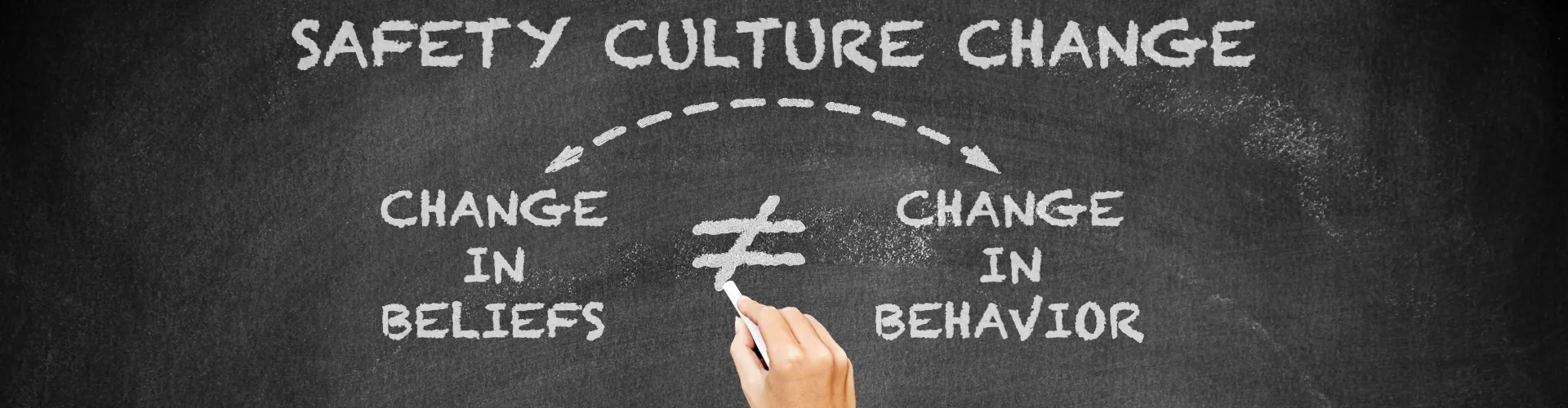
Indeed, how to change people’s minds about safety seems like the million-dollar question. But what if it’s the wrong question? Observing belief-behavior associations seems to intuitively imply that to change behavior you must first change beliefs. If the “belief drives behavior” assumption is taken for granted, individuals or organizations may focus on changing beliefs to improve safety. But before investing heavily in messaging campaigns to win the hearts and minds of workers, it’s worth challenging those basic assumptions about beliefs and behavior. I delved into the research to explore the latest thinking about the relationships between beliefs and behavior and present some key findings below.
Defining Belief and Behavior
To begin, let’s define what we mean when we’re talking about beliefs and behavior. While there is no widespread consensus across scientific disciplines about the definition of a belief, Samayoa and Albarracín (2025) provided a good working definition. They conceptualized beliefs as probability judgements that link an entity (e.g., person, place, object, or behavior) to an attribute or outcome. Beliefs can be about whether something exists, descriptions about the qualities of things, or judgements that a particular outcome will occur. Consider the following workplace safety examples:
- There are hazards in my workplace.
- My organization cares about my safety.
- Wearing PPE will help keep me safe.
Behavior, on the other hand, can be defined as any activity of a living creature. It’s what you say and do as you go about the course of your day. Sometimes people mistake adjectives for behavior. Describing words like quick, attentive, passive, or rude aren’t behavior. They may hint at underlying behaviors but fall just short. When attempting to nail down a behavior, think verbs or action. Speaking, writing, pressing, lifting, scanning for hazards – those are behaviors.
Correlations Between Beliefs and Behavior
Most people feel that our inner beliefs compel us to act. We assume that strong beliefs about environmental stewardship compel us to recycle, or that beliefs about our ability to prevent illness motivate proactive healthy behaviors. When those assumptions are examined scientifically, however, we start to see that things aren’t so straightforward.
Systematic reviews of multiple studies show that while there is often a correlation between beliefs and behavior, the strength of that relationship varies (Albarracín et al., 2024). Researchers found a medium correlation between beliefs about recycling and actual recycling behavior. The correlation between beliefs about health and engaging in specific disease prevention behaviors was small. Overall, the research suggests a moderate relationship (at best) between what people believe and what they do.
This relatively modest relationship between belief and behavior may seem counterintuitive, but I can make sense of it reflecting on my own life. I believe in being a good steward of the environment, but I admittedly don’t always recycle. I believe exercise is important, but I’ve got work to do in that domain as well. Clearly there are factors other than belief that more powerfully drive day-to-day behavior.
That’s not to suggest that beliefs don’t matter. I can see how holding apathetic beliefs about the environment or my health would make recycling or exercise even less likely (I do try after all). Given that we often find some correlation between belief and behavior, it’s worth exploring what the research says about interventions targeted at influencing beliefs and how those fare at changing behavior.
Interventions Targeted at Influencing Beliefs
Albarracín et al. (2024) provided a summary of the effectiveness of interventions aimed at changing beliefs and the effect those interventions had on behavior. One example found that interventions designed to address beliefs among adolescents were successful in reducing the likelihood of engaging in risky health behavior by 32%. Other analyses of belief-targeted interventions showed smaller impacts on behavior. For example, an analysis of ten studies designed to decrease substance use among adolescents found that there was an effect on behavior at the end of the programs, but it was too small to be of any practical importance (Hernandez Robles et al., 2018).
A third example looked at interventions aimed at fostering a “growth mindset” among students to improve academic performance (Macnamara & Burgoyne, 2022). An analysis of several of those interventions found a negligible effect on behavior and performance, even when the intervention was successful in changing mindsets. We should take care to avoid falling into the trap of assuming that behavior change will necessarily follow a change in mindset or beliefs.
Where Should Leaders Focus Their Efforts?
The research shows us that belief and behavior connections are inconsistent and often weak. It also shows that interventions to influence behavior via changing beliefs often fail to produce the desired outcomes. Where then should leaders place the bulk of their efforts and resources to get the results they need?
Albarracín et al. (2024) also provided guidance in this arena. When ranking the effectiveness of eight types of interventions on changing behavior, methods that focused on beliefs and general attitudes ranked 5th and 6th most effective, respectively. The highest ranked and most effective approaches were interventions specifically designed to promote the development of habits. The authors advised that policymakers “focus on interventions that enable individuals to circumvent obstacles to enacting desirable behaviours rather than targeting salient but ineffective determinants of behavior such as knowledge and beliefs.”
So, what does that mean for organizational safety? In plain English, cut out the middleman (beliefs and attitudes) and focus on removing obstacles to safety while promoting safe habits.
References
Furst, Peter G. (May 2025). The Role Beliefs Play in Safety. ISHN. www.ishn.com/articles/114737-the-role-beliefs-play-in-safety
Furst, Peter G. (October 2025). The Role Belief Plays in Risk Management. ISHN. www.ishn.com/articles/114965-the-role-belief-plays-in-risk-management
Furst, Peter G. (April 2022). The Role of Beliefs in Accident Prevention. ISHN. www.ishn.com/articles/113295-the-role-of-beliefs-in-accident-prevention
Albarracín, D., Fayaz-Farkhad, B., & Samayoa, J. A. (2024). Determinants of behaviour and their efficacy as targets of behavioural change interventions. Nature Reviews Psychology, 3, 377-392. https://doi.org/10.1038/s44159-024-00305-0
Hernandez Robles, E., Maynard, B. R., Salas-Wright, C. P., & Todic, J. (2018). Culturally adapted substance use interventions for latino adolescents: A systematic review and meta-analysis. Research on Social Work Practice, 28(7), 789-801. https://doi.org/10.1177/1049731516676601
Macnamara, B. & Burgoyne, A. (2022). Do growth mindset interventions impact students’ academic achievement? A systematic review and meta-analysis with recommendations for best practices. DOI:10.31234/osf.io/ba7pe
Samayoa, J. A., & Albarracín, D. (2025). Understanding belief-behavior correspondence: Beliefs and belief-to-behavior inferences. Psychological Inquiry, 36(1), 1-22. https://doi.org/10.1080/1047840X.2025.2482343