
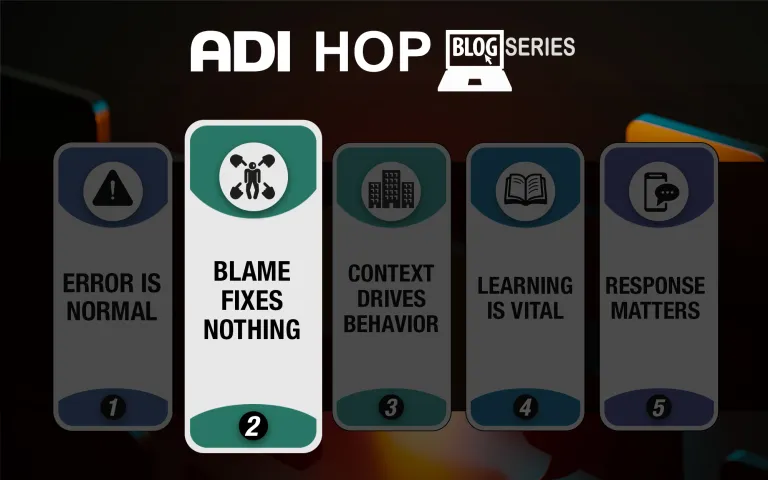
Turning HOP Principles into Action: Blame Fixes Nothing
This is the second in my 5-part blog series on the five Principles of Human and Organizational Performance (HOP). This series is written to help provide specific actions leaders can take to implement HOP. While this is not an exhaustive list, my hope is to provide behaviors leaders can adopt on a daily/weekly basis to put the HOP principles into action.
HOP Principle 2: Blame Fixes Nothing
Blame Fixes Nothing: Blame prevents learning by cutting off communication and discouraging the reporting of issues. Focusing on fault stops improvements.
Consider these concepts when pinpointing what leaders can do to put actions behind this principle.
- No one goes to work hoping to get hurt. People come to work to support their families and provide a meaningful service to organizations, which gives many people an important purpose in their lives.
- Societies, politicians, and religious figures often preach personal freedom and choice as the only mechanism that influences behavior. This ignores the role of the environment and downplays systems or systemic issues (failure points discussed in the last blog) influencing our behavior. This thinking has generalized to the workplace as well, causing kneejerk reactions when incidents or near misses occur: “They messed up.” This framing of incidents and near misses typically leads to finding fault in the performer and not the causal factors influencing the performer.
- Punishment decreases behavior and has lasting effects, both for the person and the organization. These lasting effects are rarely what leaders want. With the most generous interpretation, leaders attempt to use discipline to carve out undesired behaviors, like a scalpel, leaving a productive employee. However, what typically happens is: 1) people get better at not getting caught, 2) their total performance decreases, 3) relationships and culture diminish, and 4) these effects are long lasting as people remember how you made them feel. If you are wondering where accountability or discipline fits in, I will discuss that in my fourth blog about learning.
- Blaming the performer does not find, or fix, the root cause(s) of the undesired or at-risk behavior. These typically exist in undue production pressures, lack of resources, poor training, poorly designed work processes or procedures, lack of trained and qualified people, competing messages/priorities, etc. These are organizational issues.
What critical behaviors leaders should do to help their organizations deal with the second principle of HOP? The following are proactive behaviors or actions leaders should build into their daily/weekly habits to ensure their organization is living out this HOP principle.
Proactive Behaviors for HOP Principle 2
Develop a deep understanding of why people do what they do. In Daniel Kahnneman’s research on reframing beliefs, he noted that people rarely change their minds about important things because of the cost associated with losing their current beliefs. To successfully adopt a new belief (frame), a viable alternative must be learned. Leaders learning about behavioral science will not only make them better leaders if they apply core concepts, but it offers the best viable alternative frame for understanding why people do what they do.
Behavioral science shows how the environment (systems, processes, tools, leadership tactics, feedback, naturally occurring consequences, etc.) influence behavior. Once leaders understand why people do what they do, it will help leaders make a fundamental shift away from blaming the performer and toward looking for environmental factors that are leading to undesired or at-risk behaviors as their default approach. This new frame will benefit leaders by giving them a new way to effectively view, understand, and influence behavior. This will be discussed further in the next blog on Principle 3 (Context drives Behavior).
Develop expertise in employees’ ability to recognize and mitigate risk. To proactively prevent incidents and near misses, leaders can help employees become excellent at risk identification and hazard mitigation. This should be an ongoing activity at the leadership and organizational levels. While training and on-going workshops should be built into organizational systems, leaders can incorporate questions into their site visits to specifically seek out, identify gaps, and coach employees on these skills. Consider incorporating questions such as:
What hazards are you most concerned about on this job?
What hazards have the highest SIF potential today?
What controls (or mitigation strategies) are you going to use to do the work safely?
What will you do to keep your fellow crew members working safely?
Questions like these will help leaders identify gaps and allow for helpful coaching.
Incorporate “Start work” authority into job briefs and positively reinforce use of “Stop work” authority. “Start work” authority gives workers the ability to communicate whether they feel the job has been planned and set up well enough to keep them and their co-workers safe before starting tasks. If there is doubt by any member of the crew, those doubts can be addressed through better planning or enhanced mitigation/control strategies before any work begins on site. Both start and stop work authority should be actively encouraged and positively reinforced through positive feedback by leadership. These are key behaviors in developing a proactive safety culture.
Proactively build relationships. Good working relationships are a foundation of creating engagement over compliance when it comes to supporting safe production. When employees know you care, they will be more honest and speak up, as well as increase their discretionary effort. This also benefits the leader by increasing like and trust, which breaks down the us vs. them mentality often seen in organizations. Here are actions leaders can take to improve their working relationship with their direct reports:
- Follow through with what you say you are going to do. While this sounds like a no-brainer, it’s often true that leaders don’t follow through with commitments because things get in the way. If you tell someone you will do something, do it.
- Talk to employees on a regular basis about anything besides work. Ask them about what’s going on in their lives, how they feel about work and home life, what they did over the weekend, etc. Try incorporating this as the first thing you do in morning meetings.
- Learn at least 5 things about each employee outside of work: hobbies, family members names and interests, things you have in common, etc. Ask or talk about these things on a regular basis.
- Ask about and help people achieve their personal values and goals. This will highlight for them the connection between what they do and how it supports their goals. When you are aligned with their goals/values, your help will be perceived as more valuable to the employee.
Principles are only beneficial when people know what to do to apply them. The second principle of HOP is about making a fundamental shift away from finding fault in people. This will allow leaders to successfully identify the real root causes for undesired and at-risk behaviors and set the stage for organizational learning, Principle 4. Together, the pinpointed behaviors will neutralize the knee-jerk reaction to blame performers and set up the organization to truly learn. Building leadership habits around these principles will build a safer organization.
Reference
Kahneman, D. (2011). Thinking, Fast and Slow. Farrar, Straus, and Giroux